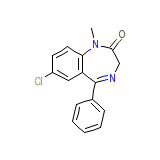
Tranquase


Tranquase Brand names, Tranquase Analogs
- Alboral
- Aliseum
- Alupram
- Amiprol
- An-Ding
- Ansiolin
- Ansiolisina
- Apaurin
- Apo-Diazepam
- Apozepam
- Armonil
- Assival
- Atensine
- Atilen
- Bensedin
- Bialzepam
- Calmocitene
- Calmpose
- Cercine
- Ceregulart
- Condition
- DAP
- Diacepan
- Dialag
- Dialar
- Diapam
- Diastat
- Diazemuls
- Diazemulus
- Diazepam Intensol
- Diazepan
- Diazetard
- Dienpax
- Dipam
- Dipezona
- Dizac
- Domalium
- Duksen
- Duxen
- E-Pam
- Eridan
- Eurosan
- Evacalm
- Faustan
- Faustan,
- Freudal
- Frustan
- Gewacalm
- Gihitan
- Horizon
- Kabivitrum
- Kiatrium
- LA III
- La-Iii
- Lamra
- Lembrol
- Levium
- Liberetas
- Mandrozep
- Methyldiazepinone
- Methyldiazepinone, Pharmaceutical
- Morosan
- Neurolytril
- Noan
- Novazam
- Novo-Dipam
- Paceum
- Pacitran
- Paranten
- Paxate
- Paxel
- Plidan
- Pms-Diazepam
- Pro-Pam
- Q-Pam
- Q-Pam Relanium
- Quetinil
- Quiatril
- Quievita
- Relaminal
- Relanium
- Relax
- Renborin
- Ruhsitus
- S.A. R.L.
- Saromet
- Sedapam
- Sedipam
- Seduksen
- Seduxen
- Serenack
- Serenamin
- Serenzin
- Servizepam
- Setonil
- Sibazon
- Sibazone
- Solis
- Sonacon
- Stesolid
- Stesolin
- Tensopam
- Tranimul
- Tranqdyn
- Tranquase
- Tranquirit
- Tranquo-Puren
- Tranquo-Tablinen
- Umbrium
- Unisedil
- Usempax Ap
- Valaxona
- Valeo
- Valiquid
- Valitran
- Valium
- Valrelease
- Vatran
- Velium
- Vival
- Vivol
- Zetran
- Zipan
Tranquase Brand Names Mixture
- No information avaliable
Tranquase Chemical_Formula
C16H13ClN2O
Tranquase RX_link
http://www.rxlist.com/cgi/generic/diazepam.htm
Tranquase fda sheet
Tranquase msds (material safety sheet)
Tranquase Synthesis Reference
Reeder, Sternbach; U.S. Pat. 3,371,085 (1968)
Tranquase Molecular Weight
284.74 g/mol
Tranquase Melting Point
125-126oC
Tranquase H2O Solubility
Slightly soluble (50 mg/L)
Tranquase State
solid
Tranquase LogP
2.988
Tranquase Dosage Forms
Tablets; Injectable solution
Tranquase Indication
Used in the treatment of severe anxiety disorders, as a hypnotic in the short-term management of insomnia, as a sedative and premedicant, as an anticonvulsant, and in the management of alcohol withdrawal syndrome.
Tranquase Pharmacology
Diazepam, a benzodiazepine, generates the same active metabolite as chlordiazepoxide and clorazepate. In animals, diazepam appears to act on parts of the limbic system, the thalamus and hypothalamus, and induces calming effects. Diazepam, unlike chlorpromazine and reserpine, has no demonstrable peripheral autonomic blocking action, nor does it produce extrapyramidal side effects; however, animals treated with diazepam do have a transient ataxia at higher doses. Diazepam was found to have transient cardiovascular depressor effects in dogs. Long-term experiments in rats revealed no disturbances of endocrine function. Injections into animals have produced localized irritation of tissue surrounding injection sites and some thickening of veins after intravenous use.
Tranquase Absorption
Essentially complete, with a bioavailability of 93%.
Tranquase side effects and Toxicity
Symptoms of overdose include somnolence, confusion, coma, and diminished reflexes. Respiration, pulse and blood pressure should be monitored.
Tranquase Patient Information
Tranquase Organisms Affected
Humans and other mammals