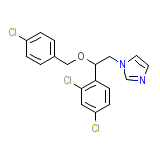
Blackburn Compound


Blackburn Compound Brand names, Blackburn Compound Analogs
Blackburn Compound Brand Names Mixture
- No information avaliable
Blackburn Compound Chemical_Formula
C18H15Cl3N2O
Blackburn Compound RX_link
http://www.rxlist.com/cgi/generic3/econazole.htm
Blackburn Compound fda sheet
Blackburn Compound msds (material safety sheet)
Blackburn Compound Synthesis Reference
No information avaliable
Blackburn Compound Molecular Weight
381.683 g/mol
Blackburn Compound Melting Point
No information avaliable
Blackburn Compound H2O Solubility
No information avaliable
Blackburn Compound State
No information avaliable
Blackburn Compound LogP
5.401
Blackburn Compound Dosage Forms
Topical cream (1%); Suppository
Blackburn Compound Indication
For topical application in the treatment of tinea pedis, tinea cruris, and tinea corporis caused by Trichophyton rubrum, Trichophyton mentagrophytes, Trichophyton tonsurans, Microsporum canis, Microsporum audouini, Microsporum gypseum, and Epidermophyton floccosum, in the treatment of cutaneous candidiasis, and in the treatment of tinea versicolor.
Blackburn Compound Pharmacology
Econazole is an antifungal medication related to fluconazole (Diflucan), ketoconazole (Nizoral), itraconazole (Sporanox), and clotrimazole (Lotrimin, Mycelex). Econazole prevents fungal organisms from producing vital substances required for growth and function. This medication is effective only for infections caused by fungal organisms. It will not work for bacterial or viral infections.
Blackburn Compound Absorption
After topical application to the skin of normal subjects, systemic absorption of econazole nitrate is extremely low. Although most of the applied drug remains on the skin surface, drug concentrations were found in the stratum corneum which, by far, exceeded the minimum inhibitory concentration for dermatophytes.
Blackburn Compound side effects and Toxicity
Overdosage of econazole in humans has not been reported to date. In mice, rats guinea pigs and dogs, the oral LD 50 values were found to be 462, 668, 272, and > 160 mg/kg, respectively.
Blackburn Compound Patient Information
No information avaliable
Blackburn Compound Organisms Affected
Yeast and other fungi