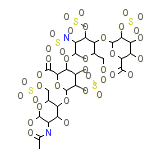
Liquaemin Sodium


Liquaemin Sodium Brand names, Liquaemin Sodium Analogs
- Alpha-Heparin
- Ariven
- Arteven
- Bemiparin
- Calcilean
- Calciparine
- Certoparin
- Clexane
- Clivarin
- Clivarine
- Dalteparin
- Depo-Heparin
- Enoxaparin
- Enoxaparin sodium
- Eparina [DCIT]
- Fluxum
- Fragmin A
- Fragmin B
- Fraxiparin
- Hed-Heparin
- Hepalean
- Heparin Cy 216
- Heparin Leo
- Heparin Lock Flush
- Heparin sodium
- Heparin sodium preservative Free
- Heparin sodium salt
- Heparin sulfate
- Heparinate
- Heparinic acid
- Hepathrom
- Leparan
- Lipo-Hepin
- Liquaemin
- Liquaemin Sodium
- Liquemin
- Low molecular weight heparin sodium
- Multiparin
- Novoheparin
- Pabyrin
- Parnaparin
- Parvoparin
- Pularin
- Reviparin
- Sandoparin
- Sodium heparin
- Sublingula
- Thromboliquine
- Vetren
- Vitrum AB
Liquaemin Sodium Brand Names Mixture
- No information avaliable
Liquaemin Sodium Chemical_Formula
(C26H40N2O36S5)n
Liquaemin Sodium RX_link
http://www.rxlist.com/cgi/generic/heparin.htm
Liquaemin Sodium fda sheet
Liquaemin Sodium msds (material safety sheet)
Liquaemin Sodium Synthesis Reference
No information avaliable
Liquaemin Sodium Molecular Weight
12000-15000 g/mol
Liquaemin Sodium Melting Point
No information avaliable
Liquaemin Sodium H2O Solubility
Soluble
Liquaemin Sodium State
Solid
Liquaemin Sodium LogP
No information avaliable
Liquaemin Sodium Dosage Forms
Solution for subcutaneous injection; Intravenous injection; Intravenous infusion
Liquaemin Sodium Indication
For anticoagulant therapy in prophylaxis and treatment of venous thrombosis and its extension, for prevention of post-operative deep venous thrombosis and pulmonary embolism and for the prevention of clotting in arterial and cardiac surgery.
Liquaemin Sodium Pharmacology
Heparin is a highly acidic mucopolysaccharide formed of equal parts of sulfated D-glucosamine and D-glucuronic acid with sulfaminic bridges. The molecular weight ranges from six to twenty thousand. Heparin occurs in and is obtained from liver, lung, mast cells, etc., of vertebrates. Heparin is a well known and commonly used anticoagulant which has antithrombotic properties. Heparin is indicated for the prophylaxis of deep vein thrombosis, which may lead to pulmonary embolism, and also for the prophylaxis of ischemic complications of unstable angina and non-Q-wave myocardial infarction, when concurrently administered with aspirin. Heparin inhibits reactions that lead to the clotting of blood and the formation of fibrin clots both in vitro and in vivo. Heparin acts at multiple sites in the normal coagulation system. Small amounts of Heparin in combination with antithrombin III (Heparin cofactor) can inhibit thrombosis by inactivating activated Factor X and inhibiting the conversion of prothrombin to thrombin. Once active thrombosis has developed, larger amounts of heparin can inhibit further coagulation by inactivating thrombin and preventing the conversion of fibrinogen to fibrin. Heparin also prevents the formation of a stable fibrin clot by inhibiting the activation of the fibrin stabilizing factor.
Liquaemin Sodium Absorption
Some oral absorption but lack of anticoagulant effect. Rapidly taken up by endothelial cells with remainder bound to plasma proteins.
Liquaemin Sodium side effects and Toxicity
Heparin sodium - Mouse, median lethal dose greater than 5000 mg/kg. Another side effect is heparin induced thrombocytopenia (HIT syndrome). HIT is caused by an immunological reaction that makes platelets form clots within the blood vessels, thereby using up coagulation factors
Liquaemin Sodium Patient Information
No information avaliable
Liquaemin Sodium Organisms Affected
Humans and other mammals