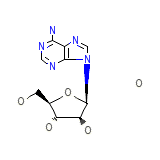
Arabinosyladenine Triphosphate


Arabinosyladenine Triphosphate Brand names, Arabinosyladenine Triphosphate Analogs
Arabinosyladenine Triphosphate Brand Names Mixture
- No information avaliable
Arabinosyladenine Triphosphate Chemical_Formula
C10H15N5O5
Arabinosyladenine Triphosphate RX_link
http://www.rxlist.com/cgi/generic3/vidarabine.htm
Arabinosyladenine Triphosphate fda sheet
Arabinosyladenine Triphosphate msds (material safety sheet)
Arabinosyladenine Triphosphate Synthesis Reference
No information avaliable
Arabinosyladenine Triphosphate Molecular Weight
285.257 g/mol
Arabinosyladenine Triphosphate Melting Point
No information avaliable
Arabinosyladenine Triphosphate H2O Solubility
No information avaliable
Arabinosyladenine Triphosphate State
Solid
Arabinosyladenine Triphosphate LogP
-2.115
Arabinosyladenine Triphosphate Dosage Forms
No information avaliable
Arabinosyladenine Triphosphate Indication
For treatment of chickenpox - varicella, herpes zoster and herpes simplex
Arabinosyladenine Triphosphate Pharmacology
Vidarabine is a synthetic purine nucleoside analogue with in vitro and in vivo inhibitory activity against herpes simplex virus types 1 (HSV-1), 2 (HSV-2), and varicella-zoster virus (VZV). The inhibitory activity of Vidarabine is highly selective due to its affinity for the enzyme thymidine kinase (TK) encoded by HSV and VZV. This viral enzyme converts Vidarabine into Vidarabine monophosphate, a nucleotide analogue. The monophosphate is further converted into diphosphate by cellular guanylate kinase and into triphosphate by a number of cellular enzymes. in vitro, Vidarabine triphosphate stops replication of herpes viral DNA. When used as a substrate for viral DNA polymerase, Vidarabine triphosphate competitively inhibits dATP leading to the formation of 'faulty' DNA. This is where Vidarabine triphosphate is incorporated into the DNA strand replacing many of the adenosine bases. This results in the prevention of DNA synthesis, as phosphodiester bridges can longer to be built, destabilizing the strand.
Arabinosyladenine Triphosphate Absorption
No information avaliable
Arabinosyladenine Triphosphate side effects and Toxicity
No information avaliable
Arabinosyladenine Triphosphate Patient Information
No information avaliable
Arabinosyladenine Triphosphate Organisms Affected
Human Herpes Viruses