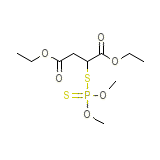
liothyronin


liothyronin Brand names, liothyronin Analogs
liothyronin Brand Names Mixture
- Nupercainal Antiseptic Crm (Dibucaine + Domiphen Bromide)
- Proctol Ointment (Dibucaine Hydrochloride + Esculin + Framycetin Sulfate + Hydrocortisone)
- Proctol Suppositories (Dibucaine Hydrochloride + Esculin + Framycetin Sulfate + Hydrocortisone)
- Proctosedyl Ointment (Dibucaine Hydrochloride + Esculin + Framycetin Sulfate + Hydrocortisone)
- Proctosedyl Sup (Dibucaine Hydrochloride + Esculin + Framycetin Sulfate + Hydrocortisone)
- Proctosedyl Suppositories (Dibucaine Hydrochloride + Esculin + Framycetin Sulfate + Hydrocortisone)
- Proctosone Ont (Dibucaine Hydrochloride + Esculin + Hydrocortisone Acetate + Neomycin Sulfate)
- Proctosone Sup (Dibucaine Hydrochloride + Esculin + Hydrocortisone Acetate + Neomycin Sulfate)
- Ratio-Proctosone (Dibucaine Hydrochloride + Esculin + Framycetin Sulfate + Hydrocortisone (Hydrocortisone Acetate))
- Sab-Proctomyxin Hc Suppositories (Dibucaine Hydrochloride + Esculin + Framycetin Sulfate + Hydrocortisone)
- Sandoz Proctomyxin Hc (Dibucaine Hydrochloride + Esculin + Framycetin Sulfate + Hydrocortisone)
liothyronin Chemical_Formula
C10H19O6PS2
liothyronin RX_link
http://www.rxlist.com/cgi/generic3/ovide.htm
liothyronin fda sheet
liothyronin msds (material safety sheet)
liothyronin Synthesis Reference
No information avaliable
liothyronin Molecular Weight
330.36 g/mol
liothyronin Melting Point
2.8 oC
liothyronin H2O Solubility
143 mg/L
liothyronin State
Liquid
liothyronin LogP
2.36
liothyronin Dosage Forms
Topical solution; Lotion
liothyronin Indication
For patients infected with Pediculus humanus capitis (head lice and their ova) of the scalp hair.
liothyronin Pharmacology
Malathion is an organophosphate insecticide commonly used to control mosquitos and other flying insects. Pharmaceutically, malathion is used to eliminate head lice. The principal toxicological effect of malathion is cholinesterase inhibition, due primarily to malaoxon and to phosphorus thionate impurities.
liothyronin Absorption
Malathion in an acetone vehicle has been reported to be absorbed through normal human skin only to the extent of 8% of the applied dose. Absorption may be increased when malathion is applied to damaged skin. Malathion is rapidly and effectively absorbed by practically all routes including the gastrointestinal tract, skin, mucous membranes, and lungs. However, it is readily excreted in the urine, and does not accumulate in organs or tissues.
liothyronin side effects and Toxicity
Malathion is slightly toxic via the oral route, with reported oral LD50 values of 1000 mg/kg to greater than 10,000 mg/kg in the rat. It is also slightly toxic via the dermal route, with reported dermal LD50 values of greater than 4000 mg/kg in rats. Moderate poisoning can result in chest tightness, difficulty breathing, bradycardia, tachycardia, tremor/ataxia, blurred vision, and confusion. Severe, life-threatening signs include coma, seizures, respiratory arrest, and paralysis. Malathion may also be irritating to the skin and eyes.
liothyronin Patient Information
liothyronin Organisms Affected
Head lice