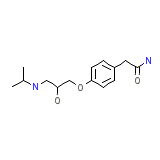
Prenolol


Categorie
Prenolol Les marques, Prenolol Analogs
- Aircrit
- Alinor
- Altol
- Anselol
- Antipressan
- Apo-Atenolol
- Atcardil
- Atecard
- Atehexal
- Atenblock
- Atendol
- Atenet
- Ateni
- Atenil
- Atenol
- Atenol 1A Pharma
- Atenol Acis
- Atenol AL
- Atenol Atid
- Atenol Cophar
- Atenol CT
- Atenol Fecofar
- Atenol Gador
- Atenol Genericon
- Atenol GNR
- Atenol Heumann
- Atenol MSD
- Atenol NM Pharma
- Atenol Nordic
- Atenol PB
- Atenol Quesada
- Atenol Stada
- Atenol Tika
- Atenol Trom
- Atenol Von CT
- Atenol-Mepha
- Atenol-Ratiopharm
- Atenol-Wolff
- Atenolin
- Atenomel
- Atereal
- Aterol
- Betablok
- Betacard
- Betasyn
- Betatop GE
- Blocotenol
- Blokium
- Cardaxen
- Cardiopress
- Corotenol
- Cuxanorm
- Duraatenolol
- Duratenol
- Evitocor
- Farnormin
- Felo-Bits
- Hipres
- Hypoten
- Ibinolo
- Internolol
- Jenatenol
- Juvental
- Lo-Ten
- Loten
- Lotenal
- Myocord
- Normalol
- Normiten
- Noten
- Oraday
- Ormidol
- Panapres
- Plenacor
- Premorine
- Prenolol
- Prenormine
- Prinorm
- Scheinpharm Atenol
- Seles Beta
- Selobloc
- Serten
- Servitenol
- Stermin
- Tenidon
- Teno-Basan
- Tenobloc
- Tenoblock
- Tenolol
- Tenoprin
- Tenoretic
- Tenormin
- Tenormine
- Tensimin
- Tredol
- Unibloc
- Uniloc
- Vascoten
- Vericordin
- Wesipin
- Xaten
Prenolol Les marques melange
Prenolol Formule chimique
C14H22N2O3
Prenolol RX lien
http://www.rxlist.com/cgi/generic/atenolol.htm
Prenolol FDA fiche
Prenolol msds (fiche de securite des materiaux)
Prenolol Synthese de reference
Barrett et al., US. 3,, 663607 (1972)
Prenolol Poids moleculaire
266.336 g/mol
Prenolol Point de fusion
146-148oC
Prenolol H2O Solubilite
13,5 mg / ml
Prenolol Etat
Solid
Prenolol LogP
1.256
Prenolol Formes pharmaceutiques
Tablet (25, 50 et 100 mg); injection intraveineuse
Prenolol Indication
Pour la gestion de hypertention et à long terme de gestion des patients atteints d'angine de poitrine
Prenolol Pharmacologie
L'aténolol, un bêta concurrentiel (1)-antagoniste sélectif des récepteurs adrénergiques, a la solubilité des lipides plus bas de cette classe de médicaments. Bien qu'il soit similaire à métoprolol, l'aténolol diffère de pindolol et propranolol en ce qu'elle n'a pas de propriétés intrinsèques sympathomimétique ou stabilisant de membrane activité. L'aténolol est utilisé seul ou avec la chlorthalidone dans la gestion de l'hypertension et un œdème.
Prenolol Absorption
dose orale, si rapide et consisten mais incomplète. Environ 50% d'une dose orale est absorbée par le tractus gastro-intestinal, le reste étant éliminé sous forme inchangée dans les fèces.
Prenolol Toxicite
DL50 = 2000-3000 mg / kg (par voie orale chez la souris). Les symptômes d'un surdosage incluent l'aténolol un rythme cardiaque lent, un essoufflement, des évanouissements, des vertiges, faiblesse, confusion, des nausées et des vomissements.
Prenolol Information pour les patients
This belongs to the group of medicines known as beta-blockers. Atenolol can
be used to treat high blood pressure, angina (chest pain) and irregular
heartbeat. It has varied effects in different parts of the body. High Blood
Pressure: Atenolol works by blocking the transmission of messages to the beta
receptors in the heart which slows down the activity of the heart, decreasing
blood pressure. Angina: Atenolol works by blocking the transmission of messages
to the beta receptors in the heart which slows down the activity of the heart
and reduces the heart's need for oxygen. This makes angina attacks less likely
to occur. Irregular Heartbeat: Normally the heartbeat is regulated by special
tissues which conduct electricity. Some cases of irregular heartbeat are caused
by these tissues conducting electricity too quickly. Atenolol works by reducing
over-activity in the conducting tissue.
be used to treat high blood pressure, angina (chest pain) and irregular
heartbeat. It has varied effects in different parts of the body. High Blood
Pressure: Atenolol works by blocking the transmission of messages to the beta
receptors in the heart which slows down the activity of the heart, decreasing
blood pressure. Angina: Atenolol works by blocking the transmission of messages
to the beta receptors in the heart which slows down the activity of the heart
and reduces the heart's need for oxygen. This makes angina attacks less likely
to occur. Irregular Heartbeat: Normally the heartbeat is regulated by special
tissues which conduct electricity. Some cases of irregular heartbeat are caused
by these tissues conducting electricity too quickly. Atenolol works by reducing
over-activity in the conducting tissue.
Prenolol Organismes affectes
Les humains et autres mammifères