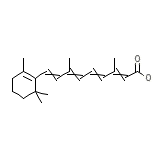
Tretinoin


Tretinoin Brand names, Tretinoin Analogs
- Aberel
- Accutane
- Airol
- Aknefug
- Aknoten
- All Trans Retinoic Acid
- All Trans-Retinoic Acid
- Amnesteem
- Avita
- Beta-Retinoic Acid
- Claravis
- Dermairol
- Eudyna
- Isotretinoin
- Lsotretinoin
- Panretin
- Renova
- Retin-A
- Retin-a Micro
- Retinoate
- Retinoic Acid
- Retinoic Acid, All Trans Isomer
- Retionic Acid
- Retisol-A
- Solage
- Sotret
- Stieva-A
- Stieva-a Forte
- Trans-Retinoic Acid
- Tretin M
- Tri-Luma
- Vesanoid
- Vitamin a Acid
- Vitinoin
- ??-Retinoic Acid
Tretinoin Brand Names Mixture
- No information avaliable
Tretinoin Chemical_Formula
C20H28O2
Tretinoin RX_link
http://www.rxlist.com/cgi/generic/tretinoin.htm
Tretinoin fda sheet
Tretinoin msds (material safety sheet)
Tretinoin Synthesis Reference
Matsui et al.; J.Vitaminol.; 4; 190, 192(1958)
Tretinoin Molecular Weight
300.435 g/mol
Tretinoin Melting Point
181 oC
Tretinoin H2O Solubility
<0.1 g/100 mL
Tretinoin State
Solid
Tretinoin LogP
5.067
Tretinoin Dosage Forms
Capsule; Cream; Gel; Liquid
Tretinoin Indication
For the the induction of remission in patients with acute promyelocytic leukemia (APL), French-American-British (FAB) classification M3 (including the M3 variant); For the topical treatment of acne vulgaris, flat warts and other skin conditions (psoriasis, ichthyosis congenita, icthyosis vulgaris, lamellar icthyosis, keratosis palmaris et plantaris, epidermolytic hyperkeratosis, senile comedones, senile keratosis, keratosis follicularis (Darier's disease), and basal cell carcinomas.); For palliative therapy to improve fine wrinkling, mottled hyperpigmentation, roughness associated with photodamage.
Tretinoin Pharmacology
Tretinoin, also known as all-trans-retinoic acid (ATRA), is a naturally occurring derivative of vitamin A (retinol). Retinoids such as tretinoin are important regulators of cell reproduction, proliferation, and differentiation and are used to treat acne and photodamaged skin and to manage keratinization disorders such as ichthyosis and keratosis follicularis. Tretinoin also represents the class of anticancer drugs called differentiating agents and is used in the treatment of acute promyelocytic leukemia (APL).
Tretinoin Absorption
1-31% (topical);
Tretinoin side effects and Toxicity
No information avaliable
Tretinoin Patient Information
No information avaliable
Tretinoin Organisms Affected
Humans and other mammals