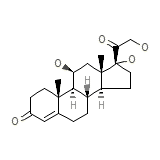
Hyton


Hyton Brand names, Hyton Analogs
- 11beta-Hydroxycortisone
- 17alpha-Hydroxycorticosterone
- A-hydrocort
- Acticort
- Aeroseb HC
- Aeroseb-HC
- Ala-Scalp
- Ala-cort
- Alacort
- Algicirtis
- Alphaderm
- Amberin
- Anflam
- Anti-inflammatory hormone
- Anusol HC
- Aquacort
- Aquanil HC
- Balneol-hc
- Barseb HC
- Basan-Corti
- Beta-hc
- CaldeCORT Spray
- Cetacort
- Clear aid
- Cleiton
- Cobadex
- Colocort
- Cortaid
- Compound F
- Cort-Dome
- Cort-Quin
- Cortanal
- Cortef
- Cortef Acetate
- Cortenema
- Cortesal
- Corticreme
- Cortifan
- Cortifoam
- Cortiment
- Cortisol
- Cortisol alcohol
- Cortisolonum
- Cortisone, tetrahydro-
- Cortisporin
- Cortisporin Otico
- Cortispray
- Cortolotion
- Cortonema
- Cortoxide
- Cortril
- Cremesone
- Cremicort-H
- Cutisol
- Delacort
- Derm-Aid
- Dermacort
- Dermaspray
- Dermil
- Dermocortal
- Dermolate
- Dihydrocostisone
- Dioderm
- Dome-cort
- Domolene-HC
- Dricort
- Drotic
- EF corlin
- Efcorbin
- Efcortelan
- Efcortelin
- Eldecort
- Eldercort
- Epicort
- Epiderm H
- Esiderm H
- Evacort
- Ficortril
- Fiocortril
- Flexicort
- Foille Insetti
- Genacort
- Glycort
- Gyno-Cortisone
- H-Cort
- Heb Cort
- Heb-Cort
- Hemsol-HC
- Hi-cor
- Hidalone
- Hidro-Colisona
- Hidrocortisona [INN-Spanish]
- Hycort
- Hycortol
- Hycortole
- Hydracort
- Hydrasson
- Hydro-adreson
- Hydro-colisona
- Hydrocort
- Hydrocortal
- Hydrocorticosterone
- Hydrocortisone Acetate
- Hydrocortisone Base
- Hydrocortisone Butyrate
- Hydrocortisone Sodium Phosphate
- Hydrocortisone Sodium Succinate
- Hydrocortisone Valerate
- Hydrocortisone [BAN:INN:JAN]
- Hydrocortisone alcohol
- Hydrocortisone free alcohol
- Hydrocortisonum [INN-Latin]
- Hydrocortistab
- Hydrocortisyl
- Hydrocortone
- Hydroskin
- Hydroxycortisone
- Hysone
- Hytisone
- Hytone
- Hytone lotion
- Idrocortisone [DCIT]
- Incortin-H
- Incortin-hydrogen
- Kendall's compound F
- Komed HC
- Kyypakkaus
- Lacticare HC
- Lacticare-HC
- Lactisona
- Locoid
- Locoid Lipocream
- Lubricort
- Maintasone
- Medicort
- Meusicort
- Micort-hc
- Mildison
- Milliderm
- Neosporin-H Ear
- Nogenic HC
- Nutracort
- Nystaform-HC
- Optef
- Orabase HCA
- Otalgine
- Otobiotic
- Otocort
- Otosone-F
- Pandel
- Pediotic Suspension
- Penecort
- Permicort
- Polcort H
- Preparation H Hydrocortisone Cream
- Prepcort
- Prevex HC
- Proctocort
- Proctofoam
- Protocort
- Racet
- Rectoid
- Reichstein's Substance M
- Remederm HC
- Sanatison
- Scalpicin Capilar
- Schericur
- Scheroson F
- Sigmacort
- Signef
- Solu-cortef
- Stie-cort
- Stiefcorcil
- Synacort
- Systral Hydrocort
- THE
- Tarcortin
- Tetrahydro E
- Tetrahydrocompound E
- Texacort
- Texacort lotion 25
- Thyrotropic-releasing factor
- Timocort
- Topicort
- Transderma H
- Traumaide
- Uniderm
- Urocortisone
- Vioform-Hydrocortisone
- VoSol HC
- Vytone
- Westcort
- Zenoxone
Hyton Brand Names Mixture
- No information avaliable
Hyton Chemical_Formula
C21H30O5
Hyton RX_link
http://www.rxlist.com/cgi/generic/hydrocortisone.htm
Hyton fda sheet
Hyton msds (material safety sheet)
Hyton Synthesis Reference
No information avaliable
Hyton Molecular Weight
362.46 g/mol
Hyton Melting Point
220 oC
Hyton H2O Solubility
320 mg/L
Hyton State
Solid
Hyton LogP
1.692
Hyton Dosage Forms
Cream; Ointment; Enemas
Hyton Indication
For the relief of the inflammatory and pruritic manifestations of corticosteroid-responsive dermatoses. Also used to treat endocrine (hormonal) disorders (adrenal insufficiency, Addisons disease). It is also used to treat many immune and allergic disorders, such as arthritis, lupus, severe psoriasis, severe asthma, ulcerative colitis, and Crohn's disease.
Hyton Pharmacology
Hydrocortisone is the most important human glucocorticoid. It is essential for life and regulates or supports a variety of important cardiovascular, metabolic, immunologic and homeostatic functions. Topical hydrocortisone is used for its anti-inflammatory or immunosuppressive properties to treat inflammation due to corticosteroid-responsive dermatoses. Glucocorticoids are a class of steroid hormones characterised by an ability to bind with the cortisol receptor and trigger a variety of important cardiovascular, metabolic, immunologic and homeostatic effects. Glucocorticoids are distinguished from mineralocorticoids and sex steroids by having different receptors, target cells, and effects. Technically, the term corticosteroid refers to both glucocorticoids and mineralocorticoids, but is often used as a synonym for glucocorticoid. Glucocorticoids suppress cell-mediated immunity. They act by inhibiting genes that code for the cytokines IL-1, IL-2, IL-3, IL-4, IL-5, IL-6, IL-8 and TNF-alpha, the most important of which is the IL-2. Reduced cytokine production limits T cell proliferation. Glucocorticoids also suppress humoral immunity, causing B cells to express lower amounts of IL-2 and IL-2 receptors. This diminishes both B cell clonal expansion and antibody synthesis. The diminished amounts of IL-2 also leads to fewer T lymphocyte cells being activated.
Hyton Absorption
Topical corticosteroids can be absorbed from normal intact skin. Inflammation and/or other disease processes in the skin increase percutaneous absorption.
Hyton side effects and Toxicity
Side effects include inhibition of bone formation, suppression of calcium absorption and delayed wound healing
Hyton Patient Information
No information avaliable
Hyton Organisms Affected
Humans and other mammals